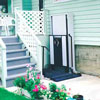
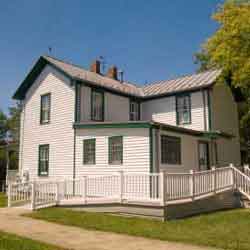
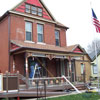
Wheelchair Ramp SlopeEasy Access to Your PorchWheelchair ramp slope is the most important consideration when building or purchasing a wheelchair ramp for access to your front porch.When my Dad was diagnosed with emphysema, he could have really benefited from a ramp to his porch. A ramp would have improved his quality of life. 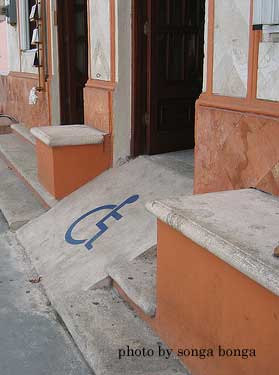
What not to do
Most people make the mistake of building a wheelchair ramp within a too confined space thereby making the slope too steep for safe use.
A steeply sloped wheelchair ramp is very difficult to climb and can result in tipping or rolling backwards without control. You want to use the lowest slope possible which means building the longest ramp possible space permitting. For access to public places the maximum wheel chair ramp slope is 1:12. That means, for every foot of ramp height from the ground, you ramp must be at least 12 feel long. We normally use public access requirements when building for residential ramps as well; however, local building codes may be different. Check with your local building codes department before building or purchasing a wheelchair ramp to ensure it complies with regulations for your area. If your porch decking material is 2 feet from the ground you would need, as a minimum, 24 feet of ramp based on a 1:12 slope requirement. Although 1:12 is the maximum slope, it is not ideal in most situations. A 1:18 or 1:20 is better. If you live in wet and icy climates, you will need more wheelchair ramp slope and rougher surfaces to prevent wheels from slipping.
One excellent way to find the right wheelchair ramp slope is to try a few ramps around your area.
Once you find one that works well for you, determine the slope and replicate if for your front porch or other access entry.
Use this Wheelchair Ramp Slope CalculatorDetermine the Slope for your Wheelchair or Mobility Cart LengthWatch the video to calculate slopeHow to Find the Wheelchair Ramp Slope of an Existing Slope
However, most of us do not have 20, 40, or 60 feet of space in which to build a ramp. The solution is to build either a 90 degree ramp or switchback. Let's say you need a 1:15 slope and your porch is two feet high. You would need a 30 foot long ramp (2x15), but you don't have that much space. Using a 90 degree ramp you could build the first portion as a 1:15 (1x15=15 feet long), then turn the ramp 90 degrees to your porch and build another 1:15 sloped ramp. Instead of needing 30 feet you'd only need 15 feet.
These are simply guidelines about wheel chair ramp slope and not intended to tell you exactly how to do it.
Please consult an expert for your particular situation.

Hi! We're Mary and Dave, lifelong DIYers, high school sweethearts, and we both love porches. You've come to the right place for thousands of porch ideas. Our Sponsors


End Sponsors Helpful LinksEnjoy shopping Amazon (affiliate link)Popular PagesWhat's NewJoin Our Newsletter Family Porch Designs Porch Ideas for Mobile Homes Find a Local Contractor Build a Porch | Small Porches Porch Columns | Porch Railings Screened Porches Porch Curtains | Porch Enclosures Porch Landscaping | Vinyl Lattice Porch Decorating | Porch Ideas Shop Navigation AidsHome | Top of PageSite Search | Site Map Contact Us PoliciesDisclosure Policy | Privacy PolicyLegal Info Please Join Us Here Also



Find a Trusted Local Pro Copyright© 2008-2024 Front-Porch-Ideas-and-More.com All rights reserved. No content or photos may be reused or reproduced in any way without our express written permission. At no extra cost to you, we earn a commission by referring you to some products on merchant sites. See our disclosure policy. We, Front Porch Ideas and More, confirm, as stated on our privacy policy, that we do not sell personal information. All content here is solely for presenting ideas. We recommend consulting with a licensed, experienced contractor before you begin your project. We make no guarantees of accuracy or completeness of information on our site or any links to other websites contained here. Thank you for taking your time to stop by. See what's popular and new here. 
|
Hi! We're Mary and Dave, lifelong DIYers, high school sweethearts, and we both love porches. You've come to the right place for thousands of porch ideas. --- Our Sponsors ---
--- End Sponsors ---Find Top-Rated Service Pros
Our Newsletter, Front Porch AppealLearn more!Thank you for being here! |
|||||
|
At no extra cost to you, we earn a commission by referring you to some products on merchant sites. See our disclosure policy.
We, Front Porch Ideas and More, confirm, as stated on our privacy policy, that we do not sell personal information. All content here is solely for presenting ideas. We recommend consulting with a licensed, experienced contractor before you begin your project. We make no guarantees of accuracy or completeness of information on our site or any links to other websites contained here. Front Porch Home | Return to Top Contact Us | About Us | Advertise with Us | Search | Site Map Media | Privacy Policy | Disclosure | Legal Notice | What's New 

|
||||||
|
No content or photos may be reproduced or copied in any way without our express written permission. 
| ||||||